

Jump
43 days to 100 miles

High jumping, then long jumping straight after, hurts more than I thought it would. Though I suppose it might not hurt as much if you actually train for it.
Everything felt OK at the time, on Monday night in Basingstoke, but now, I have serious DOMS.1 It’s almost as bad as after the SDW50 the other week. Sore right (take off) foot, tender hip adductors, tight right hamstring, stiff neck, and a general sense of fatigue.
The Hampshire Veterans Athletics League (aka The Vets League) is, in my opinion, one of the most wonderful athletics events there is. Over four evenings between April and July each year, eight Hampshire clubs come together to compete against each other. There are men’s and women’s categories across three age groups (35+. 50+ and 60+). Depending on the event each team can nominate one or two scorers (A and B), but all events are also open to “non-scorers”. if you want to race, you can race.
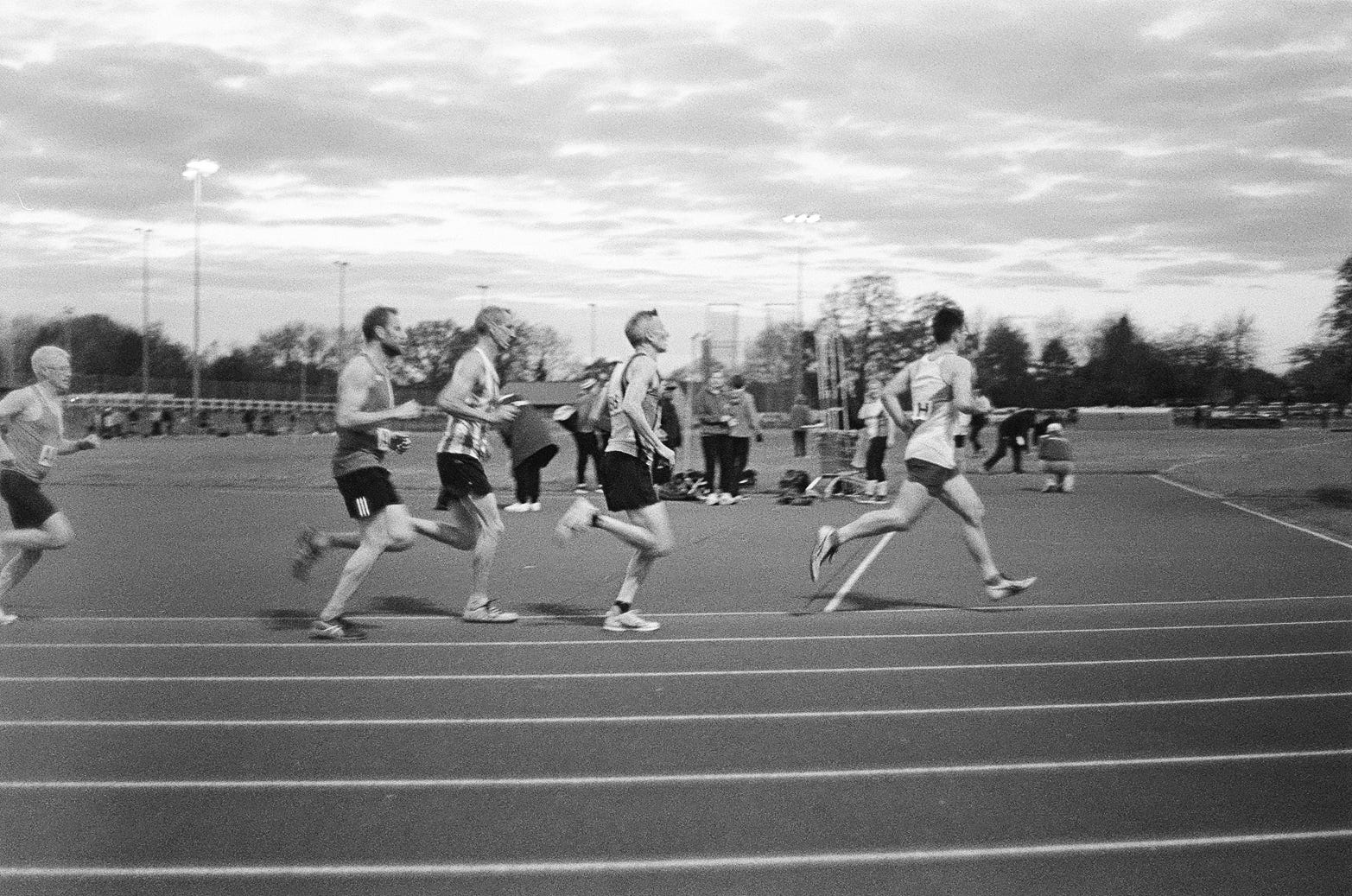
There are a few things that make The Vets League so wonderful:
It’s a proper, grassroots, amateur competition made possible by volunteers.
You end up meeting clubmates from different training groups.
There’s no minimum standard. If you’re old enough, you’re good enough. It keeps people in the sport and it is not uncommon to have athletes in their 80s on the same team as those in their 30s, with newcomers alongside lifers.
The overall team score is the most important thing. All scorers get points (8 for 1st down to 1 for 8th), so even if you end up last in the B string, you can still contribute something to the team. This fosters such a strong team spirit in what is often an individual sport.
I’m not often quick enough to be selected as a scorer, but I’ve stepped forward on a number of occasions when a sprinter has got stuck in traffic, or a relay runner has twanged a hamstring, for example. Battling for points, to try and help the team win the league, is such a motivator to run a decent race.
In recent seasons, the Southampton AC women have won their side of the league, but the men seem to have got stuck behind Basingstoke.
Other than a few open meetings, my track career began four years ago, at the age of 37 (I’d have started at 35, but the league was cancelled for two years due to Covid).
Last year, during my dalliance with sprinting, I raced the 100, 200 and 400m, ran in various relays, and even had a go at the Triple Jump (I still don’t know which leg to take off from). My 7 points in the B string 400, from running 60.0” for 2nd place, at Basingstoke last year is possibly the hardest I’ve ever run. In prior years, I’ve also ticked off the long jump, 800, 1500, 3000m and various relays. All of which is to say that I’ve managed to do most events, except for the throws (my arms are not built for throwing), steeplechase (too perilous), pole vault (where to begin?) and high jump.
With very little speed work in my legs over the past nine months, I didn’t see the benefit of entering any of the distance races on Monday, so decided to give the high jump a go. I’ve not attempted it since school and had done no training at all. I got a few tips from other athletes, but for the most part I tried to copy what I’ve seen the pros do on telly. For a complete beginner, with ultra miles in my legs, I did OK. I cleared 1.35m, which I felt good about until I realised that some athletes weren’t coming in until 1.50m. Basingstoke’s Neil Barton won with 1.65m. He then went and won the long jump with 5.84m. That’s no great surprise considering he is one of the top masters athletes in Europe.
My long jump was shoddy. Four years ago I had managed 4.22m, but I had no pop left in my legs by this point. I posted a sequence of 3.20, 3.78 (off my left leg as I messed up my run up), and 3.83m.
As a non-scorer, my results didn’t matter. I competed because The Vets League is fun. It’s debatable whether there’s much ultramarathon training benefit, but it certainly broke up the monotony. The next edition falls during my peak mileage week, so I’ll probably give competing a miss and volunteer instead. If you want to see Hampshire’s finest masters athletes (and some not-so-fine) go head to head, come to Southampton Sports Centre on the evening of Monday 18 May.
This is volume one, issue thirty-one of ¡Venga!, a running journal by Jonathan S. Bean.
Volume one: ‘326 days to 100 miles,’ documents Jonathan’s preparation for, and participation in the South Downs Way 100 mile race on 13 June 2026. The journal is published on Substack and as a paper newsletter sent by post.
Subscribe to receive new posts in your email inbox, for free
Subscribe to receive the print edition of each newsletter, posted to your door, for £5 a month.
I’m writing this on Wednesday evening, but will publish on Friday to fit my loose publishing schedule. If you’re not sure what DOMS means, it’s Delayed Onset Muscle Soreness and describes the aches that tend to arise a day or two after a race when the inflammation has had time to develop.
More track fun…?
I don't know that I can do this

Last night I ran a 200 metre race; my twelfth sprint race of a four-and-a-bit month track season. In 326 days I intend to run a 100 mile race. From a 27.92 second event to one that may take 27 hours, with less than eleven months to prepare.