

Bobbing
93 days to 100 miles

An hour to the top
There is no path but a stream
I smell lanolin.
Jack is training for a Bob Graham Round attempt. Recently, I joined him for a brilliant weekend of recce runs and camping.
Richard Askwith’s Feet in the Clouds was one of the first (and still one of the best) books about running that I read, possibly fifteen years ago. Like many readers, it planted a small seed in my brain, wondering “Could I do it?” 60+ miles, 42 peaks in a day? “How hard could it be?”
Following my two long days in the western Lake District with Jack, I now know the answers to those two questions: “Nope” and “Very.”
To clarify that first answer: I have a base level of fitness that is probably sufficient for a Bob Graham Round-specific training plan to not be an unimaginable step up. After all, I’m currently training for a 100 mile race with a 30 hour time limit. Based on distance and duration, the SDW100 is further than the Bob.
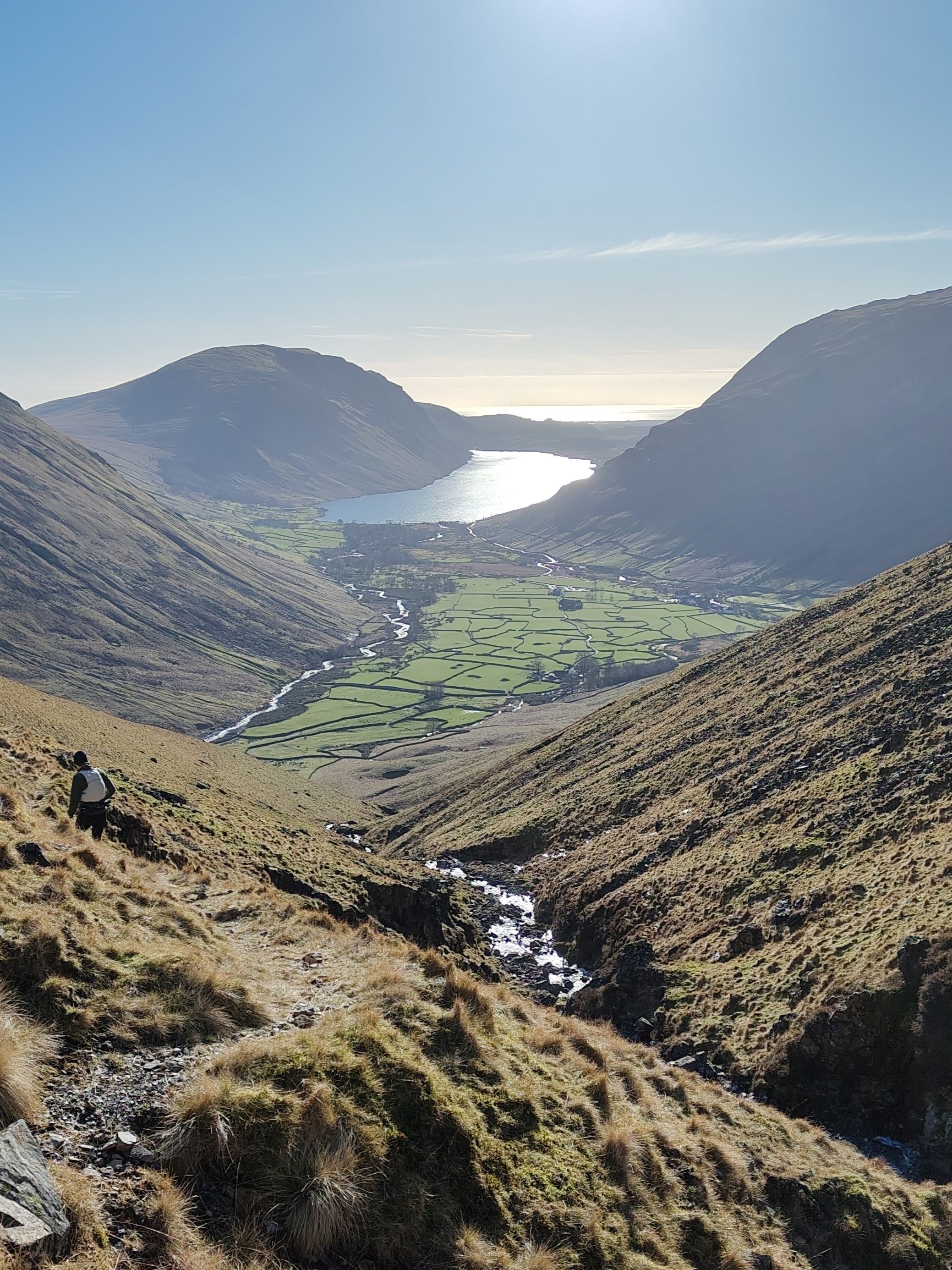
The problem is where it takes place. Someone who lives in the Alps might scoff at the notion of English mountains (our highest peak Scafell Pike is less than 1,000m tall - a fifth of Mont Blanc) but the Lake District is mountainous (or mountain-ish at the very least). The hills are steep, the climbs long, and the terrain often rocky
.
The challenge of the Bob Graham Round is further complicated by the time limit. The quickest route between two peaks is rarely along a recognised path, requiring navigation skills to make sure time isn’t lost through deviation (there are no signposts to follow).
All this means, that someone considering a Bob Graham Round attempt needs to be very familiar with the landscape, efficient at long climbs and descents, and know the route. It’s not just about fitness and the ability to keep moving for a long time.
If, like me, you live in the South, at the other end of the country to the Lake District, I don’t think you can expect to run a successful Bob Graham Round unless you’re willing to dedicate a significant chunk of your life to travelling north and putting in the miles on recce runs, and walking and running holidays. Not just one or two, but loads - sufficient to know the area well enough to navigate off path, in the dark, when tired. The Lakes have to become an obsession.
It’s what Richard Askwith describes in Feet in the Clouds, it’s what my friend Rob did when he completed the BGR a couple of years ago, and it’s what Jack is doing (fortnightly recce trips, on top of a decade of holidays and a three day walking BGR a few years back).
This all became very apparent when running with Jack. My ultra fitness, and (admittedly relatively limited) mountain running experience got me through, and I had a lot of fun, but it was tough. I felt like a tourist, but Jack looked like a local.
In two days we covered about 34 miles, with close to 15,000 feet of climbing. The total moving time was sixteen hours. The longest climbs took more than an hour, with the longest downhills much the same. We climbed snow-filled gullies and descended straight down a stream (the fastest way off a hill is usually whatever route the water is taking)
As a two-day running experience (and an ultra-training weekend), it was fantastic. I would rank it as one of my favourite running experiences to date. But I now know exactly how big the gulf is between my current ability and what it would take to give the Bob a decent crack. I have so much respect for anyone who gives it a go, but it’s not a challenge I want to undertake. I’m an ultrarunner, a trail runner, even a mountain runner (occasionally), but I’m not a Bob-runner. That’s another level.
I will very happily return to the Lakes, and would love to spend more long days out on my feet, but the Bob isn’t on my to-do list.
It’s been a busy couple of weeks with work, and I’m trying to maintain a high overall running mileage, so I feel too tired to write poetically enough to do justice to the landscape Jack and I ran through that weekend. I might have to return to the subject on another occasion.
When I do, I’ll be sure to write about the hours upon hours of conversation, the light and dark of the weather, ascending through microclimates, thumbache from poles, espresso in the slate mine café, underfloor heating in the shower block, wet gloves from snow crawling, fording an ice-cold stream, the sour smell of the drying room, and the musky scent of sheep on the wind.
Until then, you can have the haiku at the start of this issue.
Training update: I’m on track, with a reasonably high overall mileage, and a 41km (one km per year) mixed terrain “birthday run” the other day. My training is going to be interrupted for the next week or so, but I should be able to get a 50km run and a nice taper in before the SDW50 mile race in early April.
This is volume one, issue twenty-three of ¡Venga!, a running journal by Jonathan S. Bean.
Volume one: ‘326 days to 100 miles,’ documents Jonathan’s preparation for, and participation in the South Downs Way 100 mile race on 13 June 2026. The journal is published on Substack and as a paper newsletter sent by post.
Subscribe to receive the print edition of each newsletter, posted to your door, for £5 a month.
(or subscribe for free to receive new posts by email)
More mountains…
I'm not Kilian Jornet (and that's OK)

Is Kilian Jornet the most influential trail runner? Probably. He’s certainly one of the most well-known, setting records and winning races since. Yet, despite his significance within the sport, Jornet is not necessarily representative of it.